


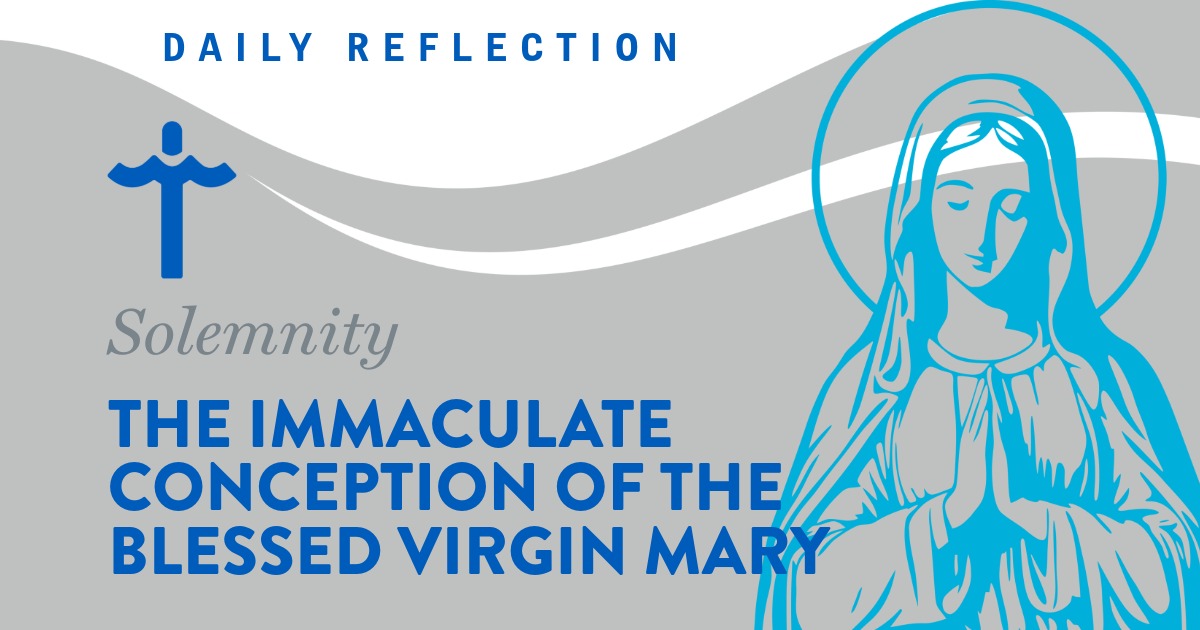
Paul VI calls this feast “a joint celebration” of three things: “of the Immaculate Conception of Mary, of the basic preparation for the coming of the Savior (Isaiah 11:1, 10), and of the happy beginning of the Church without spot or wrinkle.”
This is a challenge to faith: can you really see yourself as “perfect” in heaven? Do you believe no trace of any sin you ever committed will remain? That you will be as totally free of sin and all its consequences as the Blessed Virgin Mary? That everyone there — in fact, the whole redeemed human race — will be “without spot or wrinkle,” totally without “blemish” or “blame”? Is that something to exult in?
The Opening Prayer tells us God let Mary “share beforehand in the salvation Christ would bring… and kept her sinless from the first moment of her conception.” The power to preserve is the power to restore. The Preface calls her “our pattern of holiness,” God’s “sign of favor to the Church in its beginning and the promise of its perfection as the bride of Christ, radiant in beauty.” What Mary was from the beginning of her life, we will be at the end of ours. The Preface for the feast of the Assumption, seeing in her “the pattern of the Church in its perfection, and already the beginning of it realised, cries out to God in praise,” She is a “sign of hope and comfort for your people on their pilgrim way.” That is what we celebrate
The first reading from Genesis 3:9-20 shows us ‘the beginning and the pattern” of the human race in its sinfulness. The sad story of Adam and Eve’s unfaithfulness to God has been repeated countless times in human history and is still being repeated every day. Adam and Eve just weren’t grateful enough for what they had. And they weren’t conscious enough — although perfectly cognizant — of where it came from. They actually thought for a moment that they could enhance their being by acting in opposition to Being Itself. They thought they could have more by trying to be independent of the One from whom everything comes. That they could make the gift of life better in separation from the Giver.
We ourselves do it all the time. What is sin but the same stupidity? And what will protect us against it?
A New Start
Luke 1:26-38 is the new Genesis story. There is a woman: Mary. And an angel speaks to her, as one did to Eve in the garden. She is at first “troubled” or “perplexed” by his words, as we can presume Eve was at first by the suggestion of the serpent. The angel’s words contain a promise, as the words of Satan did. Mary believed in the promise, as Eve believed in the promise made to her. Both accepted to do what they were urged to do. What was the difference between them?
Mary was listening to good; Eve to evil. What Eve was urged to do was disobedience; God had forbidden it. What Mary was urged to do was obedience; God was asking it. Eve acted in pride, wanting to be “like God.” Mary acted in humility, wanting only to serve God. Because of Eve’s “Yes,” the human race was deprived of grace, the gift of being like God. Because of Mary’s “Yes,” all who echoed her would become like God in a way beyond imagination: by sharing in the divine life of God himself. Because of the fruit Eve took, until the end of time, the “fruit of her womb” would be cursed with suffering and sin. Because of the fruit Mary gave, in the “fullness of time,” all who accepted the “fruit of her womb” would be “blessed with every spiritual blessing in the heavens.”
Every Eucharist announces to us again the Good News of Christ’s coming. Every Eucharist leads us in hymns and prayers of praise. Every Eucharist invites us to believe in the promise of our redemption, and to let the words spoken to us be made flesh in action. Every Eucharist says to us, “If you hear and do, blessed is the fruit of your life.”
Prayer Prompt: How can I replicate Mary’s Yes in my life? Discover what aspects of your daily life can be used to produce the fruits of your faith. God knows what we are destined for, as he did for Mary. What is God asking of me?
— Fr. David M. Knight
View today’s Mass readings, Lectionary #689, on the USCCB website here
Fr. David M. Knight (1931-2021) was a priest of the Diocese of Memphis in Tennessee, a prolific writer, and a highly sought after confessor, spiritual director, and retreat master. He authored more than 40 books and hundreds of articles that focus primarily on lay spirituality and life-long spiritual growth.





0 Comments